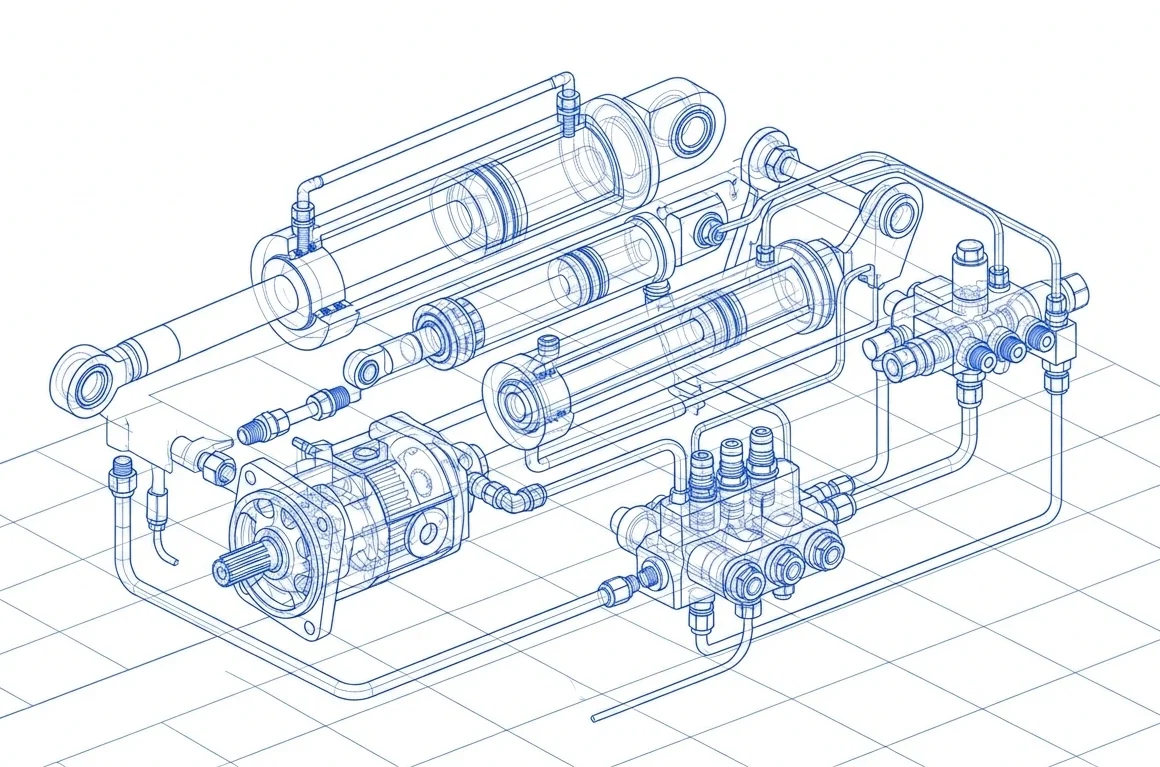


\Hydraulic components are essential to the operation of excavators, loaders, forklifts, agricultural machinery, mining equipment, earth movers, and industrial hydraulic systems. These components must combine mechanical strength with dimensional accuracy so that they can withstand repeated loading, maintain proper alignment, and work reliably with seals, cylinders, valves, and other mating parts.
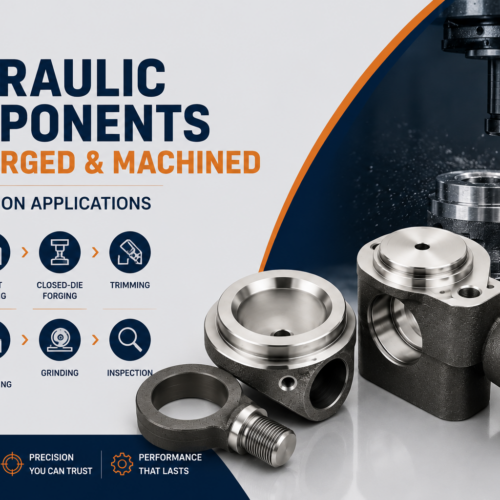
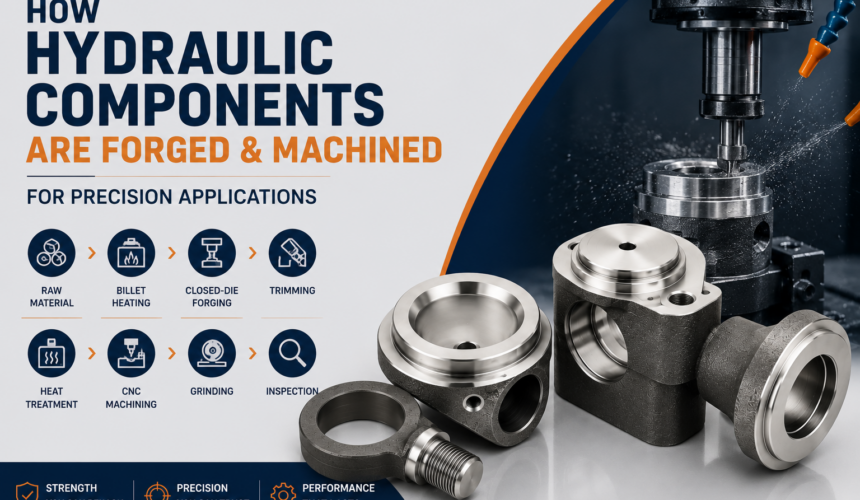
For this reason, hydraulic component manufacturing involves more than simply forming a metal part. The manufacturing route can include raw-material selection, induction billet heating, closed-die forging, trimming, heat treatment, surface finishing, precision machining, grinding, and final inspection. MTF’s published forging process specifically includes raw-material testing, induction billet heating, closed-die forging, trimming, in-house heat treatment, shot blasting/surface finishing, and final inspection.
When these stages are properly controlled, manufacturers can produce precision hydraulic components with consistent geometry, controlled material properties, accurate functional surfaces, and repeatable quality for demanding applications.
What Is Hydraulic Component Manufacturing?
Hydraulic component manufacturing is the process of producing metal components used in hydraulic systems through a combination of forming, heat treatment, machining, finishing, and inspection operations.
Depending on the component design, the manufacturing process may be used to produce:
- Hydraulic cylinder end caps
- Cylinder heads
- Rod ends
- Clevises
- Mounting components
- Hydraulic fittings
- Adapters
- Connection components
- Valve-related components
- Other forged and machined hydraulic parts
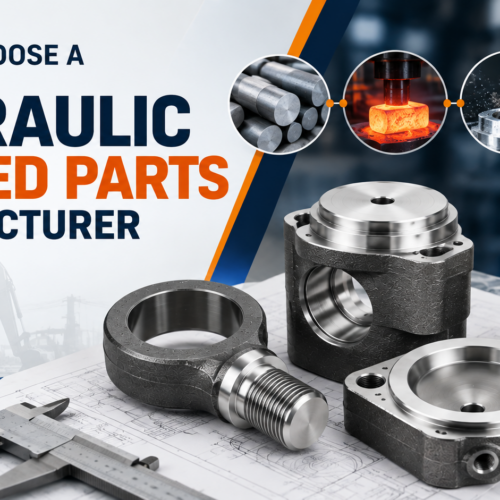
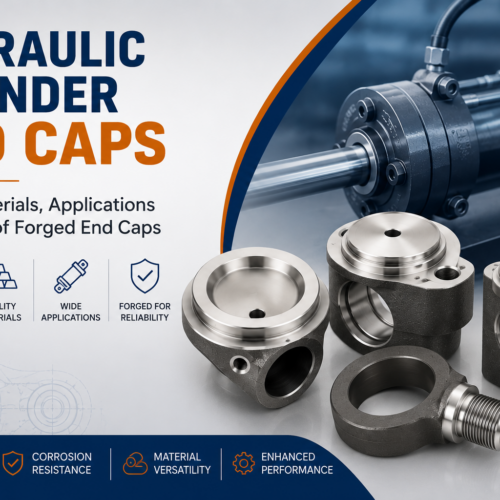
MTF’s current hydraulic product range specifically includes multiple machined hydraulic cylinder end caps for agricultural equipment, supporting the relevance of forged and machined end-cap components within its hydraulic manufacturing offering.
The manufacturing route depends on the component’s material, geometry, dimensions, production volume, application, and required mechanical properties.
For components requiring a combination of strength and precision, forging followed by machining can provide an effective manufacturing approach.
Hydraulic Component Manufacturing Process: Step by Step
The production of forged hydraulic components generally involves several controlled stages. Each stage has a specific purpose in achieving the required component quality.
1. Raw Material Selection and Testing
The manufacturing process begins with the selection of suitable raw material.
Material selection depends on the component’s mechanical requirements, operating environment, geometry, machining requirements, and customer specifications.
MTF states that it works with materials including carbon steel, alloy steel, micro-alloyed steel, stainless steel, and tool steel across its forging operations.
Before forging, raw materials can be checked according to the required specifications. Important considerations can include:
- Material grade
- Chemical composition
- Dimensions
- Surface condition
- Mechanical properties
- Material traceability
MTF’s published forging workflow specifically identifies raw material selection and testing, including chemical and mechanical validation, as the first stage of its forging process.
Proper material selection establishes the foundation for the subsequent forging, heat treatment, machining, and inspection operations.
2. Raw Material Preparation
After material selection and verification, the raw material is prepared for the forging operation according to the required component size and forging design.
The preparation stage ensures that the material is suitable for controlled heating and subsequent forming.
For production components, consistent material preparation helps maintain repeatability in the forging process and supports controlled material flow during forming.
Rather than specifying a particular cutting method for every hydraulic component, the exact preparation route should depend on the material, component size, forging design, and production requirements.
3. Induction Billet Heating
Before forging, the billet is heated to a controlled temperature suitable for the selected material and forging process.
MTF specifically uses induction billet heating in its forging operation, with its current forging page identifying three induction billet-heating lines and controlled heating for stable forging performance.
Controlled heating is important because the material must reach a suitable temperature for plastic deformation while maintaining process consistency.
Temperature control can involve monitoring:
- Heating temperature
- Heating time
- Temperature uniformity
- Transfer time from heating to forging
Consistent billet heating helps support repeatable deformation and controlled material flow during forging.
4. Closed-Die Forging
The heated billet is transferred to the forging equipment, where it is shaped using specially designed dies.
In closed-die forging, the metal is progressively formed within the die cavity to achieve the required component geometry.
MTF’s forging infrastructure includes screw presses, forging hammers, and induction billet heaters, while its published process specifically identifies closed-die forging using screw presses and hammer lines.
The forging stage influences:
- Component geometry
- Material flow
- Dimensional consistency
- Machining allowance
- Structural characteristics
Closed-die forging can be used to produce features such as:
- Flanges
- Bosses
- Mounting sections
- Reinforced areas
- Connection sections
- General component profiles
For suitable hydraulic components, forging provides the basic structural shape before the component moves to subsequent operations.
5. Trimming and Flash Removal
After forging, excess material known as flash may remain around the forged component.
The trimming process removes this unwanted material and produces a cleaner forged profile.
MTF specifically identifies trimming and flash removal as part of its controlled forging workflow.
Trimming prepares the forged component for subsequent heat treatment, surface preparation, machining, and inspection.
Consistent trimming also helps establish predictable material conditions for downstream operations.
6. Heat Treatment
After forging and trimming, the component may undergo heat treatment according to the material grade and required mechanical properties.
Heat treatment can be used to develop the required combination of:
- Hardness
- Strength
- Toughness
- Wear resistance
- Mechanical stability
MTF operates in-house heat-treatment furnaces and identifies normalizing, quenching, and tempering within its forging capabilities.
The exact heat-treatment cycle depends on the selected material and component specification.
Controlled heat treatment is especially important for forged components that will experience repeated mechanical loading during service.
The objective is to achieve the required material properties before the component proceeds to precision machining and final inspection.
7. Shot Blasting and Surface Preparation
Following forging and heat treatment, surface preparation may be required before machining or final finishing.
MTF’s published forging process includes shot blasting and surface finishing, describing this stage as preparation for machining or coating.
This stage can help remove surface scale and prepare the forged component for subsequent manufacturing operations.
The exact surface-treatment requirement depends on the component, material, machining route, and customer specification.
8. Precision Machining
Forging produces the basic component geometry, but many hydraulic components require highly accurate functional features.
This is where precision machining becomes essential.
MTF’s machining infrastructure currently includes CNC turning, VMC machining, milling, boring, drilling, grinding, tapping, and other finishing operations. Its machining page also identifies CNC turning, CNC milling, drilling and boring, grinding, and broaching as available processes.
For hydraulic components, the relevant machining operations can include:
- CNC turning
- VMC/CNC milling
- Drilling
- Boring
- Tapping
- Grinding
- Other precision finishing operations
The machining process can create accurate:
- Bores
- Threads
- Seal grooves
- Mounting surfaces
- Ports
- Mating surfaces
- Holes
- Critical dimensional features
For example, a forged hydraulic cylinder end cap may require accurate machining of its bore, mounting interface, threads, and sealing grooves before it can be assembled into a cylinder. MTF’s current hydraulic product range includes machined end caps for hydraulic cylinders used in agricultural equipment.
This combination of forging and machining is why forged machined components can be suitable for applications where both structural strength and dimensional precision are required.
Technical note: HMC and VTL have not been included because MTF’s current public website does not clearly establish those specific machine types. VMC, CNC turning, milling, boring, drilling, grinding, and tapping are supported by the current machining information.
9. Grinding and Surface Finishing
Certain hydraulic components require additional finishing after machining.
Grinding can be used where tighter dimensional control and specific surface-finish requirements are necessary.
MTF’s machining capabilities specifically include grinding and surface finishing, including grinding for performance-critical mating surfaces.
For hydraulic components, surface finish can be particularly important for areas that interact with:
- Seals
- Bushes
- Mating surfaces
- Other precision interfaces
A properly finished surface can help support accurate assembly and reliable interaction between mating components.
Not every forged component requires grinding. The requirement depends on the component’s design, tolerance, material, and application.
10. Inspection and Quality Control
The final stage of hydraulic component manufacturing is inspection, although quality checks can also take place throughout earlier stages.
Inspection verifies that the finished component conforms to the applicable drawing, specifications, and quality requirements.
Depending on the component, inspection may cover:
- Dimensional accuracy
- Bore diameter
- Thread dimensions
- Surface finish
- Concentricity
- Flatness
- Mounting dimensions
- Overall geometry
- Material properties
- Surface condition
MTF’s machining and hydraulic pages identify ZEISS CMM dimensional inspection, contour testing, surface roughness testing, hardness testing, chemical composition testing, and microstructure analysis as part of its quality and inspection capabilities.
For OEM applications, inspection and traceability are particularly important because components may need to meet defined dimensional and material specifications consistently across production batches.
Why Is Precision Important for Hydraulic Components?
Hydraulic systems contain multiple components that must work together accurately.
A hydraulic cylinder, for example, may include a barrel, piston, piston rod, seals, head, end cap, and mounting components. The interfaces between these parts need to maintain appropriate dimensions and alignment.
Even relatively small dimensional variations can influence:
- Assembly
- Sealing
- Alignment
- Movement
- Component wear
- Service life
This is why precision hydraulic components require controlled machining and inspection in addition to the initial forging operation.
The combination of forging, heat treatment, surface preparation, machining, finishing, and inspection allows manufacturers to address both structural and dimensional requirements.
Forging and Machining: Why Use Both Processes?
Forging and machining serve different purposes within component manufacturing.
Forging is used primarily to create the basic component shape and establish the material characteristics required for the application.
Machining is then used to achieve the accurate dimensions and functional features needed for assembly.
This combination creates a complete manufacturing route from forged blank to finished component.
Hydraulic Parts Forging and Machining Manufacturer
For OEMs, working with a hydraulic parts forging and machining manufacturer can provide a more coordinated manufacturing process because forging and subsequent precision machining can be managed within an integrated production environment.
Using both processes can provide several manufacturing advantages:
- Strong forged component geometry
- Controlled material usage
- Reduced machining from solid material
- Accurate functional surfaces
- Repeatable dimensions
- Controlled manufacturing workflow
- Application-specific component geometries
MTF describes its manufacturing model as an integrated route covering forging, heat treatment, machining, and inspection. Its current infrastructure also identifies dedicated forging and machining capabilities within the manufacturing operation.
This makes the combined process relevant to many forged machined components used in hydraulic and heavy-equipment applications.
Applications of Forged and Machined Hydraulic Components
The requirements for hydraulic components vary according to the machinery and operating environment.
Construction Equipment
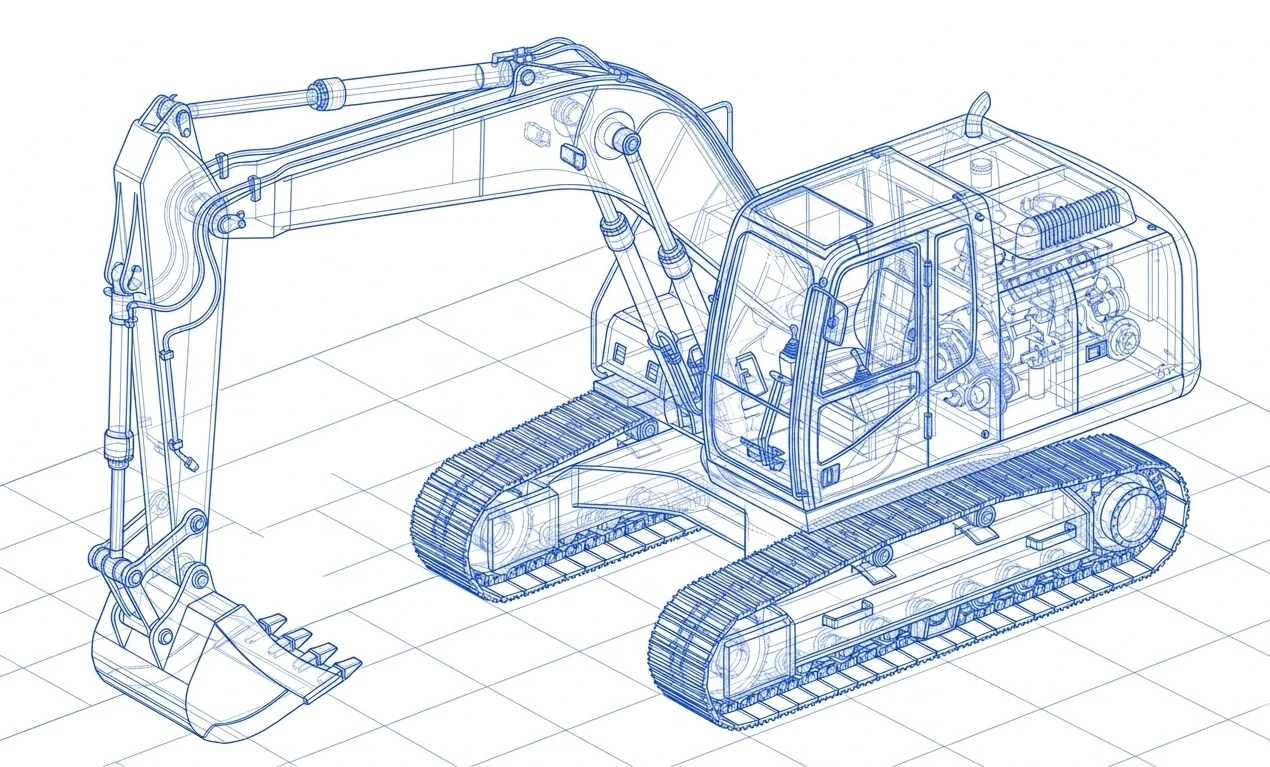
Excavators, loaders, backhoe loaders, and earth movers use hydraulic systems for digging, lifting, tilting, and positioning.
Their components experience repeated movement, mechanical loading, vibration, and impact.
Agricultural Equipment
Tractors, harvesters, agricultural implements, and other machinery use hydraulic systems for lifting, steering, positioning, and implement control.
Consistent component dimensions are important for reliable assembly and operation. MTF’s hydraulic product range currently includes machined hydraulic cylinder end caps specifically listed for agricultural equipment.
Mining Equipment
Mining machinery operates under demanding conditions involving heavy loads, vibration, impact, dust, and extended operating cycles.
Forged components can be considered where mechanical strength and fatigue resistance are important.
Forklifts and Material Handling
Forklifts use hydraulic cylinders for lifting and tilting functions.
Components used in these systems need to maintain reliable fit, alignment, and performance over repeated operating cycles.
Choosing Hydraulic Component Manufacturers in India
When selecting hydraulic forged parts manufacturers in India, buyers should evaluate the manufacturer’s complete production capabilities.
Important factors include:
- Raw-material control
- Forging capacity
- Closed-die forging capabilities
- Die and tooling expertise
- Induction billet heating
- Heat-treatment facilities
- Precision machining capabilities
- Grinding and finishing
- Dimensional inspection
- Quality-control systems
- Material traceability
- Engineering drawing capability
- Production consistency
MTF’s current infrastructure includes 6,800 MT annual forging capacity, 3.6 million machined parts per year, in-house die development and tool management, CNC turning centres, VMCs, grinding, broaching, and automated production systems.
A manufacturer offering forging, heat treatment, machining, and inspection under an integrated production system can provide better control over the complete manufacturing cycle.
This is particularly useful for OEMs requiring repeatable precision hydraulic components according to defined drawings and specifications.
Metalic Technoforge for Forged and Machined Hydraulic Components
Metalic Technoforge combines forging and machining capabilities for the production of engineered metal components used across demanding industrial applications.
Its manufacturing approach covers key stages including closed-die forging, induction heating, trimming, heat treatment, surface finishing, precision machining, grinding, and inspection, allowing components to progress through multiple manufacturing stages within a coordinated production environment. metalictechnoforge.com
For hydraulic applications, this capability can support the production of components requiring controlled forged geometry, accurate machining, sealing surfaces, mounting interfaces, and dimensional consistency.
MTF’s dedicated hydraulic offering includes forged and precision-machined components for hydraulic systems, while its published product range includes multiple machined hydraulic cylinder end caps for agricultural equipment.
For OEMs and equipment manufacturers sourcing hydraulic components, an integrated manufacturing capability can help maintain consistency from raw material through to the finished component.
Frequently Asked Questions About Hydraulic Component Manufacturing
What is hydraulic component manufacturing?
Hydraulic component manufacturing is the process of producing components used in hydraulic systems through operations such as material preparation, forging, heat treatment, machining, finishing, and inspection.
What are hydraulic components made from?
Many hydraulic components are manufactured from carbon steel, alloy steel, stainless steel, or other engineering materials selected according to mechanical, environmental, and application requirements.
Why are hydraulic components forged?
Forging can provide a strong and durable component structure and is suitable for many load-bearing geometries. The forged component can then be precision machined to achieve its required dimensions and functional surfaces.
What is closed-die forging?
Closed-die forging shapes heated metal within specially designed dies to produce a controlled component geometry. MTF’s current forging process specifically uses closed-die forging through screw press and hammer lines.
What machining processes are used for hydraulic components?
Depending on the component, machining can include CNC turning, VMC/CNC milling, drilling, boring, tapping, grinding, and other precision finishing operations. The exact process depends on the component geometry and required tolerances.
Why is machining used after forging?
Machining creates accurate features such as bores, threads, seal grooves, mounting surfaces, ports, and mating interfaces that generally require tighter dimensional control than the forged geometry alone can provide.
What are precision hydraulic components?
Precision hydraulic components are hydraulic parts manufactured with controlled dimensions, tolerances, surface finishes, and functional interfaces so they can be accurately assembled and perform consistently within a hydraulic system.
What should I look for in a hydraulic component manufacturer?
Look for capabilities covering forging, induction heating, heat treatment, precision machining, grinding, inspection, material control, and traceability, along with the ability to manufacture components according to engineering drawings and application requirements.
Conclusion
The production of reliable hydraulic components requires control across the entire manufacturing process. From raw-material selection and induction billet heating to closed-die forging, trimming, heat treatment, surface preparation, precision machining, grinding, and inspection, every stage contributes to the final component.
Forging provides the basic structural geometry, while machining and finishing create the precise features required for assembly, sealing, alignment, and operation. When these processes are integrated with appropriate quality control, manufacturers can produce precision hydraulic components with consistent dimensions and application-specific mechanical properties.
For OEMs and equipment manufacturers, selecting an experienced partner for hydraulic component manufacturing is therefore important for achieving repeatable quality and reliable component performance across construction, mining, agriculture, material handling, and other hydraulic applications.